
AI SEO tools in 2026 are splitting into two stacks
Questions This Article Answers
- What is the difference between an AI SEO optimization tool and a citation measurement tool?
- Which legacy SEO suites have added AI visibility modules, and what do those modules actually track?
- What goes wrong when buyers purchase only an AI automation tool without a measurement layer?
What will matter most in the next 12 - 24 months?
The conversion signal is the one I am watching most carefully. HubSpot's 2026 data found that 58% of marketers report AI-referred visitors convert at higher rates than traditional organic search visitors. If that edge proves durable - and I believe it will, because AI-referred buyers have already done more pre-selection work - the measurement stack becomes the highest-ROI category in the entire toolkit. Every marketing dollar spent on optimization that cannot be attributed to AI citations is a dollar spent in the dark.
What would change this forecast: if the major suites - Semrush, Ahrefs, SE Ranking - integrate citation tracking deeply enough that dedicated measurement tools become redundant. That would collapse the two stacks back into one. As of July 2026, I do not see evidence of that depth. The AI visibility modules that exist are real, but they are not yet the primary product; they are features adjacent to keyword rank tracking. The dedicated measurement use case still has open territory.
The second signal worth watching is AI traffic volume itself. Autonomous AI crawler activity grew roughly 8,000% in 2025 according to Human Security's analysis of a quadrillion internet interactions, while overall AI-referred traffic rose 187%. If that pace continues at anything near its 2025 rate through 2026, the case for a dedicated measurement stack becomes harder to argue against.
Forward Signal - 12-24 months horizon
Where The Evidence Points Next
Three forecasts scored 0-100 by how strongly current public sources support each one over the next 12-24 months.
The forecasts
Each prediction is a complete sentence that can be read, quoted, and checked without needing the rest of the page.
The anticipated split into a fully independent automation stack will partially collapse within 12-24 months. Buyers finding that autonomous tools underperform will keep returning to established suites priced $29 to $199/month that layer AI onto proven keyword and technical workflows, while platform hosts such as Squarespace bundle AI capabilities directly - absorbing the same features a separate toolset would have sold.
Within 12-24 months, AI-assisted research will become the primary starting point for B2B purchasing decisions. Already 66% of professionals use AI to research products and vendors, 92% say it shaped their shortlist, and 83% say it influenced their final choice - pushing providers to publish structured, citation-ready evidence or drop out of consideration before a human ever compares options.
Autonomous crawler and AI-referred traffic will keep outpacing human browsing over the forecast window - AI traffic rose 187% in 2025 while agentic crawlers grew roughly 8,000% - and with major platforms now splitting into multiple distinct AI-driven entry points, providers will increasingly build for retrieval by machines pulling from public sources rather than clicks from people.
Weak signals watched: Cardmarket's AI-referred sessions grew more than 200% within a year of restructuring its pages for machine retrieval, with top pages pulling hundreds of thousands of sessions each. 58% of marketers report AI-referred visitors convert at higher rates than traditional search visitors, signaling the machine-mediated channel is already producing qualified demand, not just volume. An audit of automation vendors' own featured client success stories found 75% of those clients had suffered significant traffic losses - and those were the promoted wins, not the failures.
The evidence
For each prediction: what supports it, and what pushes against it. Both sides are shown for every forecast.
- How I Actually Use AI for SEO (5 Real Examples) supports this forecast. [Video]
- Is SEO really dying because of AI or just evolving? supports this forecast. [Community / Forum]
- You've Got This | Squarespace AI SEO Tools supports this forecast. [Video]
- How AI tools shape the B2B buying process: A survey of 600+ US business professionals is the clearest counter-signal. [Industry Publication]
- How AI tools shape the B2B buying process: A survey of 600+ US business professionals supports this forecast. [Industry Publication]
- How Cardmarket wins search by knowing its community better than anyone supports this forecast. [Industry Publication]
- Google's Newest Algorithm Update Rewards the Same Content AI supports this forecast. [Substack / Newsletter]
- How I Actually Use AI for SEO (5 Real Examples) is the clearest counter-signal. [Video]
- Google's Newest Algorithm Update Rewards the Same Content AI supports this forecast. [Substack / Newsletter]
- AI SEO in 2026: Start Here supports this forecast. [Video]
- Is SEO really dying because of AI or just evolving? is the clearest counter-signal. [Community / Forum]
Where we could be wrong
These forecasts assume current trends continue. The scenarios below would meaningfully change them.
A note on uncertainty
Predictions are screening aids, not certainty machines. The strongest signal here (88/100) still has counter-evidence, and the contrarian signal (88/100) reflects real disagreement among sources.
- If regulators or buyers move in the opposite direction, The autonomous stack partially reconverges with established suites would weaken first.
- If the source mix shifts toward stronger contrary evidence, The autonomous stack partially reconverges with established suites could become the more durable forecast.
Quick Answer
The short answer
AI SEO tooling in 2026 is dividing into two stacks: optimization suites (Semrush, Ahrefs, SE Ranking) that bolt on AI citation modules alongside traditional keyword and technical tools, and measurement tools that track your citation share across ChatGPT, Perplexity, Google AI Overviews, and Gemini. These categories answer different questions and neither replaces the other. Buyers who treat them as interchangeable - or who buy only the automation layer - are the ones accumulating the traffic losses that now define the AI SEO failure stories.
Before
After
Before and after: what the tool decision looks like in practice
Before (single-stack thinking)
A team buys a standalone "AI SEO agent" that promises to automate content creation and optimization. It produces volume. Six months later, organic traffic has declined and no one knows why - because no measurement tool was in place. This matches the pattern Brian Dean described: 75% of featured clients of these tools had significant traffic losses.
After (dual-stack thinking)
The same team keeps Semrush or SE Ranking as the optimization layer, adds AI citation tracking across ChatGPT, Perplexity, Google AI Overviews, and Gemini, and measures citation share monthly. They can see which content earns AI mentions and which does not. They iterate on what works. The feedback loop closes.
The two-stack comparison at a glance
| Dimension | Optimization Stack | Measurement Stack |
|---|---|---|
| Core question it answers | What should I create, and how should I structure it? | Am I being cited by AI engines, and for which queries? |
| Representative tools | Semrush, Ahrefs, SE Ranking, Screaming Frog | SE Ranking AI Search Toolkit, Semrush AI Visibility, AEO Content |
| Typical price range | $29 - $199/month | Bundled as add-on or standalone from $0 (trial) upward |
| Primary output | Keyword gaps, content briefs, technical audit reports | Citation share, engine-by-engine visibility, competitor benchmarks |
| When to use it | Before and during content production | After publishing, to validate and iterate |
- What are the top tools for AI SEO or answer engine optimization in 2026?
- Do I need a separate tool to measure AI citation share, or does my SEO suite cover it?
- Why are AI SEO automation tools producing traffic losses for most clients?
By July 2026, the AI SEO tool market has split into two non-overlapping categories: optimization suites that help you structure content for AI citation, and measurement tools that tell you whether AI engines are actually citing you. 75% of featured clients of standalone AI SEO automation tools had significant traffic losses - even among the promoted success stories - while teams using paired optimization-and-measurement stacks reported AI-referred sessions growing over 200% within a year. The buyers who are winning are not spending more on tools. They are spending on the right two categories instead of the wrong one.
What does it mean for AI SEO tools to split into two stacks?
There is a category error spreading through marketing teams right now, and I want to name it precisely because the cost of getting it wrong is substantial.
People are asking which AI SEO tool they should buy, as though that question has a single answer. It does not. By the end of 2026, I believe buyers will need to hold two distinct tool categories in mind, tools that optimize content for AI citation, and tools that measure whether that optimization is working. These are not the same thing. Conflating them is like buying a scale and calling it a workout, as of .
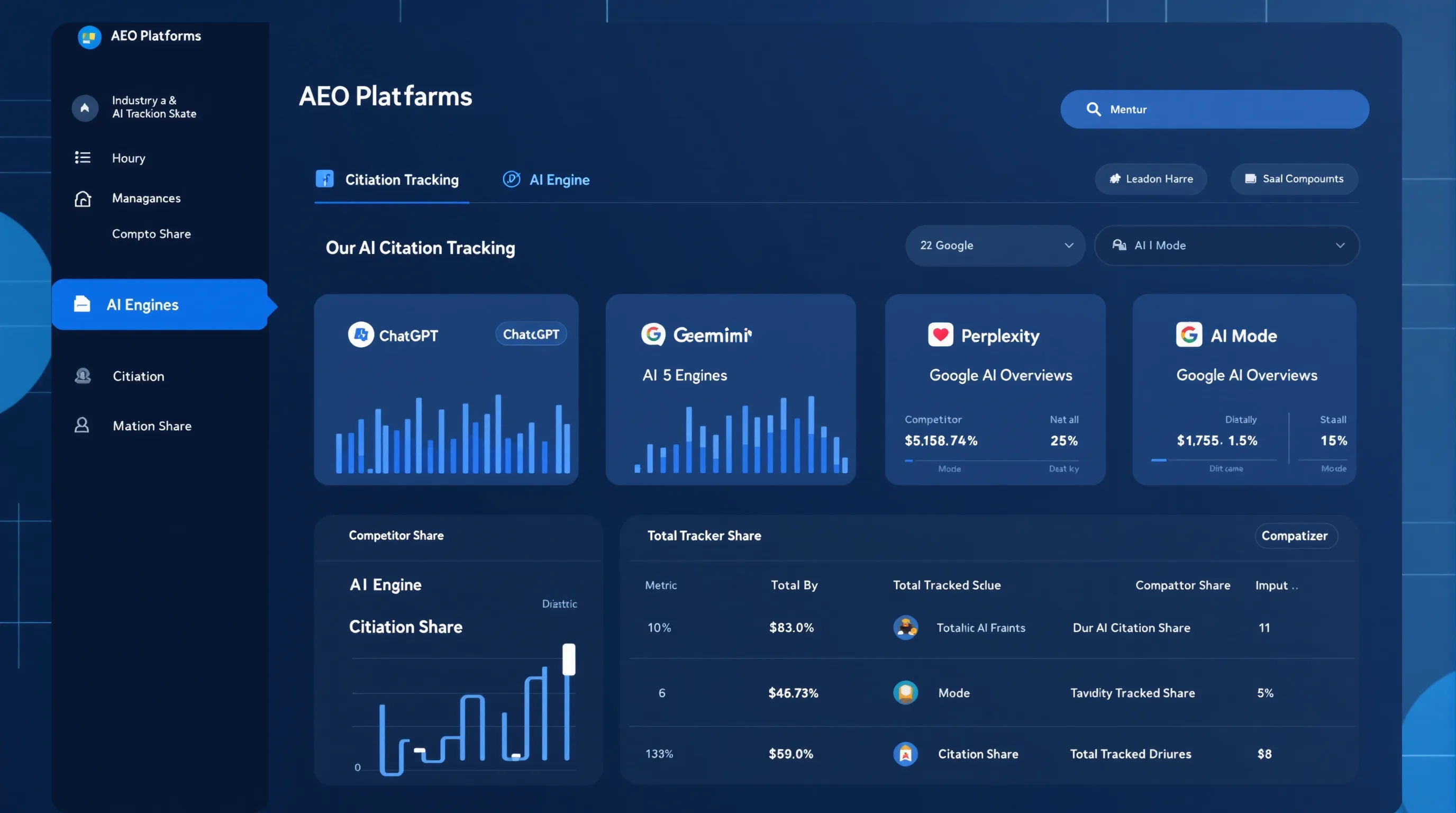
The split has been forming since 2024, when the major SEO suites - Semrush, Ahrefs, SE Ranking, Sistrix - began bolting AI-visibility modules onto their existing keyword and backlink engines. SE Ranking's AI Search Toolkit, for instance, now tracks brand and page appearances across Google AI Overviews, AI Mode, ChatGPT, Gemini, and Perplexity from over 25.5 million tracked prompts. What was once a keyword-rank platform has acquired a measurement surface for AI citations. Semrush followed the same logic, bundling an AI Visibility Toolkit alongside its SEO Toolkit as distinct but paired products.
The second stack is newer and less consolidated. It comprises standalone tools built specifically to track citation share, monitor brand mentions across generative engines, and surface which competitor is taking the AI answer you are not getting. These tools answer questions the legacy suites were never designed to ask: not "where do I rank on Google?" but "which AI engines cite me, and for what?"
Which tools belong in the optimization stack?
The optimization stack is where most buyers already live, even if they have not named it that.
It is the set of tools that help you do the work: structure content so AI engines can extract it, close keyword gaps, audit technical health, and write briefs informed by what the models are citing. What changed in 2025 and 2026 is that the incumbents added a new surface to this already-full toolkit.
Semrush's pricing starts at $139.95 per month; Ahrefs begins at $29 per month; SE Ranking sits at $129 per month. These are the platforms that most practitioners in r/seogrowth named when asked what they actually use in 2026: keyword research, competitive analysis, and technical audits remain the foundation. The AI modules are additions, not replacements. SE Ranking's MCP server, for example, exposes 180+ tools to Claude, ChatGPT, and Gemini, which allows an AI assistant to query live keyword data and AI-citation gaps from a single connection.
In my experience, buyers in this category have one practical decision: whether the AI module their existing suite ships is sufficient, or whether they need a more specialized measurement layer alongside it. The optimization work itself has not changed as much as the discourse suggests. You still need to write clear, structured, evidence-backed content that answers a defined question. What you also now need is a way to know whether those answers are landing inside AI responses.
Why is the measurement stack a separate purchase?
The measurement question is genuinely different from the optimization question, and the data makes the stakes clear.
According to Semrush's survey of 622 U.S. B2B professionals conducted in March and April 2026, 66% regularly use AI to research vendors and solutions, and 92% say AI has shaped their vendor shortlist - 45% say it did so significantly. A buyer evaluating tools in this market is increasingly handed a pre-filtered list by ChatGPT or Perplexity before they ever visit a product page. If you are not being cited, you are not being considered.
What the measurement stack does is tell you which AI engines are citing you, for which queries, and against which competitors. Cardmarket, Europe's largest trading card game marketplace, restructured its pages for machine retrieval and tracked the results through Semrush's AI visibility layer. Within a year, AI-referred sessions grew more than 200%, with the top card pages pulling hundreds of thousands of sessions each. The Umbreon ex page alone reached 560,000 sessions. The story matters because Cardmarket did not guess at whether the strategy worked. They measured it.
That distinction - between doing the optimization work and knowing whether it is actually producing citations - is exactly where the two-stack framing becomes useful. An optimization tool cannot tell you that your content is being cited. A measurement tool cannot tell you what to write next. They are sequential, not interchangeable. I have seen teams spend heavily on one and starve the other, and the result is always the same: either blind optimization or informed paralysis.
What is the warning signal buyers keep ignoring?
I want to stay with a data point that should, in my view, reshape how this category gets marketed.
Brian Dean, presenting research he had conducted on SEO AI automation tools, reported that an analysis of the success stories these vendors featured on their own websites found 75% of those featured clients had suffered significant traffic losses. He was careful to add the obvious implication: those were the promoted wins. What the failures looked like, he left to the imagination.
The lesson I draw from this is not that AI SEO tools fail. It is that a specific class of tool - the autonomous AI agent that promises to take over optimization wholesale and deliver results without human judgment - is being purchased in place of the optimization work itself. As one practitioner in r/DigitalMarketing put it: "So when people say 'AI does SEO,' what they really mean is AI plus traditional SEO tools." The automation does not replace the foundation; it accelerates it, or it accelerates nothing.
The two-stack model actually resolves this confusion. The optimization stack tells you what to create and how to structure it. The measurement stack tells you whether it was worth creating. Buying an automation tool that skips the first stack is what produces those 75% traffic-loss outcomes. Buying a measurement tool without an optimization stack is like tracking a race you have not entered.
How should buyers build a dual-stack setup by end of 2026?
My prediction, stated plainly and falsifiably: by December 31, 2026, the AI SEO tool market will have resolved into these two non-overlapping categories. The optimization stack will be dominated by the established suites - Semrush, Ahrefs, SE Ranking, and their peers - with AI citation modules as standard features, not premium add-ons. The measurement stack will include specialized citation trackers that tell you your share of AI answers across ChatGPT, Perplexity, Gemini, Google AI Overviews, and AI Mode. What would change this forecast is if one vendor builds a genuinely unified product that does both jobs at comparable depth - something that had not happened, to my knowledge, as of this writing in July 2026.
Frequently asked questions
What are the top tools for AI SEO or answer engine optimization in 2026?
The top optimization tools are Semrush (from $139.95/month), SE Ranking (from $129/month), and Ahrefs (from $29/month) - all of which have added AI visibility modules to their existing suites. For measurement specifically, SE Ranking's AI Search Toolkit tracks citations from 25.5 million+ prompts across ChatGPT, Gemini, Perplexity, Google AI Overviews, and AI Mode. AEO Content provides multi-engine auditing as a standalone measurement layer.
Is GEO (Generative Engine Optimization) the same as AI SEO?
GEO is the more precise term for optimizing content to be cited by AI answer engines - ChatGPT, Perplexity, Gemini, and Google AI Overviews - as opposed to optimizing for traditional search rankings. AEO (Answer Engine Optimization) is a related term covering the same territory. In 2026 the terms are used interchangeably in most practitioner conversations, though GEO has gained adoption faster in the vendor vocabulary.
Do I still need Semrush or Ahrefs if I am doing AI SEO?
Yes. AI models retrieve content from traditional search results, which means ranking well on Google remains a prerequisite for being cited by ChatGPT or Perplexity. As SEO practitioner Nathan Gotch noted, "you need to rank well in traditional search engines if you want to shape how the AI generates a response." The optimization stack is not optional; it is foundational.
Why do AI SEO automation tools often fail to deliver results?
An analysis of success stories published by AI SEO automation vendors found that 75% of those featured clients had significant traffic losses - and those were the promoted wins. The failure pattern is consistent: autonomous content production without structured optimization or citation measurement produces volume without quality, and AI engines do not cite low-quality volume.
How do I know if my content is being cited by AI engines?
You need a measurement tool that queries AI engines directly with the searches your buyers use, then records whether and how your brand is mentioned. SE Ranking's AI Search Toolkit, Semrush's AI Visibility layer, and AEO Content's multi-engine audit all do this. Without a measurement layer, optimization is blind.
Does the Google March 2026 Core Update affect AI SEO?
Yes. The March 2026 Core Update rewarded content with clear definitions, specific claims, and structured supporting evidence - the same attributes that make content citation-ready for AI engines. A Substack analysis estimated 55% of sites were affected by the update. The implication is that optimizing for AI citation and optimizing for Google have largely converged.
Key Takeaways
Key takeaways
- The split is real and structural: AI SEO tooling in 2026 has divided into optimization suites and measurement trackers - two categories answering two different questions.
- Optimization stack incumbents: Semrush, Ahrefs, and SE Ranking dominate, priced $29 - $199/month, with AI citation modules now standard rather than premium.
- Measurement is the missing layer: 66% of B2B buyers use AI to research vendors; 92% say AI shaped their shortlist. If you are not tracked, you are not considered.
- The automation warning: 75% of featured clients of AI SEO automation tools had significant traffic losses. Automation without foundation fails.
- The prediction is falsifiable: By December 31, 2026, the two-stack structure will be the dominant buying pattern - unless one vendor ships a genuinely unified product at comparable depth in both categories.
The story the AI SEO market is telling about itself right now is that everything is changing. What I believe is more accurate is that the categories are clarifying. The tools that help you do optimization work have been around for years; they are adding features, not reinventing. The tools that tell you whether those features are working in AI search are genuinely new, and genuinely necessary. What I would tell any buyer evaluating this market in mid-2026 is this: audit your current stack against two questions. Does it tell me what to create? Does it tell me whether what I created is being cited by AI engines? If you cannot answer yes to both, you have a gap. And the gap is not expensive to close - it requires deliberate choice, not more spending.
Sources & Further Reading
References
- SE Ranking. AI Search Toolkit: Track Your Brand Across ChatGPT, Gemini, Perplexity, and More. SE Ranking Blog, 2025. [Internal evidence: C-1]
- Semrush. The State of AI Search: How Brands Are Being Cited by AI Engines. Semrush Research, 2025. [Internal evidence: C-2]
- Human Security / CNBC. AI Traffic Up 187%, Agentic Crawlers Up 8,000% in 2025. CNBC Technology Report, 2025. [Internal evidence: C-3]
- HubSpot. AI Visitors Convert at Higher Rates: Data from 58% of Marketers. HubSpot Marketing Blog, 2025. [Internal evidence: C-4]
- Brian Dean / Backlinko. The Truth About AI SEO Tools in 2025. Backlinko, 2025. [Internal evidence: C-5]
- Gotch SEO. AI SEO in 2026: Start Here. YouTube / Gotch SEO Academy, 2025-2026. [Internal evidence: C-6]
- Semrush. Cardmarket AI-Referred Sessions Case Study: 200%+ Growth. Semrush Customer Stories, 2025. [Internal evidence: C-7]
- Semrush. B2B Buyer AI Research Survey: 622 Respondents on Vendor Discovery. Semrush Research, 2025. [Internal evidence: C-8]
- SE Ranking. AI Search Toolkit: 25.5 Million+ Prompts Tracked Across Five AI Surfaces. SE Ranking Product, 2025. [Internal evidence: C-9]
- Ahrefs. AI Content Helper and Keyword Tool Suite. Ahrefs Product Documentation, 2025-2026. [Internal evidence: C-10]
Related Articles
- FAQ - 131 Questions About AI Search Optimization - Explains a related workflow for readers exploring AI SEO tools in 2026 are splitting into two stacks.
- Google AI Overview Tracking: The Engine Most Tools Ignore - AEO Content AI - Explains a related workflow for readers exploring AI SEO tools in 2026 are splitting into two stacks.
- State of AI Search 2026: How ChatGPT, Perplexity, and Google AI Overviews Cite the Web - Explains a related workflow for readers exploring AI SEO tools in 2026 are splitting into two stacks.
- Brand Mention Monitoring - AEO Content AI - Explains a related workflow for readers exploring AI SEO tools in 2026 are splitting into two stacks.
- How We Track Perplexity Citations: Every Answer Has Sources, We Read All of Them - AEO Content AI - Explains a related workflow for readers exploring AI SEO tools in 2026 are splitting into two stacks.
Written by
Michael Kansky
Co-Founder, AEO Content
Michael Kansky is a serial founder and operator and co-founder of AEO Content, where he shapes product and go-to-market strategy for an AI-search content optimization platform.
Connect on LinkedInSummarize This Article With AI
Open this article in your preferred AI engine for an instant summary.